Build language skills
with flashcards!

Let’s learn and play!

The Verb Box

Sagnorðakassinn
The verbs are classified by their inflection ending in the present singular

The verb flashcards are an excellent tool for learning:

  • vocabulary
  • sentence structure with auxiliary verbs
  • word order of sentences with adverbs of frequency
  • phrasal verbs
  • conjugation of verbs
  • verb moods (e.g. imperative and past participle)
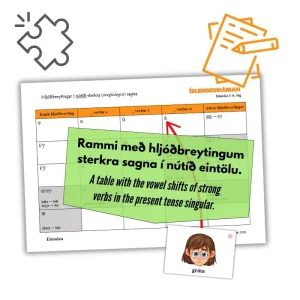
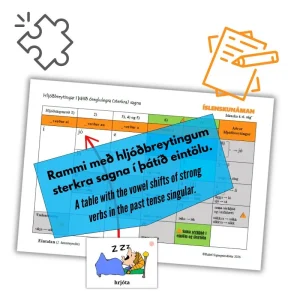
  • vowel shifts in verbs
  • case governance of verbs
The verb flashcards can be used in a wide variety of ways and at all learning levels..

Sentence formulas

At this level, the usage of sentences with auxiliary verbs is recommended when talking about different tenses or aspect.

Present tense

  • Ég er að … (núna)
  • Ég ætla að … (á eftir/á morgun)
  • Ég þarf að … (á eftir/á morgun)

Past tense

  • Ég var að … (áðan/í gær)

✪ Recommendations for first time users:

  1. Choose verbs that can be used without an object
  2. Add common adverbs of frequency and time phrases
  3. Get familiar with basic word order in Icelandic.

➤ Sigurður Hermannsson, a linguist and second language teacher in Icelandic, has written at least three articles on basic word order in Icelandic. Beginners who read English can be referred to the article Basic Word Order.

When starting out, it’s recommended to focus on everyday activities or your daily.

Simple declarative sentence

  • Ég … (á hverjum degi)
  • Hann/Hún/Hán… (á hverjum degi)

Simple interrogative sentence (direct yes or no question)

  • … þú (á hverjum degi)?

✪ Recommendations for first time users:

  1. Choose verbs that can be used without an object
  2. Go through each category of verbs (a-, i-, 0-verbs in this order) separately, starting only with their conjugation in singular.
  3. Add common adverbs of frequency and time expressions (both for regular actions and the future). 
  4. Learn the basics of word order in Icelandic.

➤ Sigurður Hermannsson, a linguist and second language teacher in Icelandic, has written at least three articles on basic word order in Icelandic. Those who read English can be referred to the article Basic Word Order – V2.

When starting out, it’s recommended to focus on everyday activities or your daily habits.

Simple declarative sentence

  • Ég … (áðan/ í gær)
  • Hann/Hún/Hán… (áðan/í gær)

Simple interrogative sentence (direct yes or no question)

  • … þú (áðan í gær)?

✪ Recommendations for first time users:

  1. Choose verbs that can be used without an object
  2. Choose common adverbs and phrases about the past.


According to my experience, most students are ready to add the past tense of a-verbs (rulegroup 1) by the middle of level 2, but the conjugation of i-verbs (rulegroup 2) proves to be more difficult for them. Therefore, I would recommend emphasising the past tense of a-verbs at level 2 (A1.2), and i-verbs at level 3 (A2.1). 

It should also be noted that some verbs that have an irregular (strong) conjugation in the present tense (0-verbs) have a regular (weak) past tense conjugation (0-/i-verbs = mixed/hybrid verbs).

Starting at least from level 3 (A2.1) onvards, you should start to get to know the past participle* as well as starting to create sentences with the help of the verb flashcards.

Examples of sentence formulas:

  • Initiating conversations: Hefur þú … [object/prepositional phrase]?
  • Example of politeness: Getur þú … [object/objects/prepositional phrase]?


*The past participle has two forms in Icelandic:

A. The one that stands with the verb “að vera” (to be) and behaves like an adjective (some are actually counted with them, such as “soðinn” (boiled)).

B. The one that stands with the auxiliary verb “að hafa” (have) or the modal verb “að geta” (can) and is in the last place among the key forms (principal parts) of verbs. (called “sagnbót” (supine) on bin.arnastofnun.is). This is the past participe form you should focus on.

In most cases, the present subjunctive can be started at level 4 (A2.2). However, most aren’t ready to form sentences with a verb in the subjunctive mood until levels 5-6 (B1.1-B1.2).

According to my experience, students are best able to create sentences that includes subjunctive mood when they are given these sentence formulas to complete:

Present tense

  • Ég held að …
  • Ég hugsa að …
  • Ég vona að …

Past tense

  • Ég hélt að …
  • Ég vonaði að …
  • Ég vissi ekki að …

More products

More products

Conversations

Theme boxes

Textbook

Puplished February 17. 2026